Hair Transplantation
Eyebrow Transplant
Natural, Face-Balanced & Long-Lasting Design
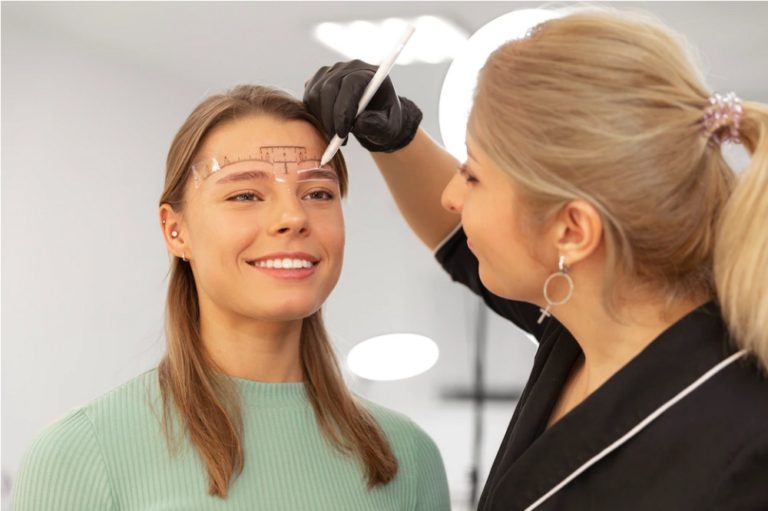
Eyebrows play a major role in facial expression. Their shape, density, thickness, starting point, arch and tail can significantly influence how the eyes and the face are perceived.
Eyebrow transplantation uses your own hair follicles to reconstruct or increase eyebrow density. At Dr Ahmet Demir Clinic, DHI eyebrow transplantation and long-hair eyebrow transplantation are our preferred approaches in suitable patients.
Contents
- Long-Hair Eyebrow Transplant: See the Design Immediately
- What Is an Eyebrow Transplant?
- The Most Important Step: Eyebrow Design
- Female and Male Eyebrow Design
- Direction and Angle Matter
- Why We Prefer DHI for Eyebrows
- How Is a Long-Hair Eyebrow Transplant Performed?
- Will the Long Eyebrow Hairs Shed?
- Where Are Eyebrow Grafts Taken From?
- Who May Benefit?
- Preliminary Assessment
Long-Hair Eyebrow Transplant: See the Design Immediately
In a long-hair eyebrow transplant, selected donor follicles are harvested while the hair shafts are kept long. This allows the direction, curvature and overall design to be seen at the end of the procedure.
There are two main donor-harvesting options: keeping the donor hairs fully unshaven, or creating a small concealed donor window that can be covered by the surrounding longer hair.
Fully unshaven harvesting is technically more demanding and may take around six hours, while a concealed donor shave can shorten the procedure to approximately four hours.
What Is an Eyebrow Transplant?
Fine follicular units are harvested from the donor area and implanted into the eyebrow region. Wherever possible, fine single-hair grafts are selected to create a softer and more natural appearance.
The Most Important Step: Eyebrow Design
Facial shape, eye position, the existing eyebrows, forehead and temple proportions, asymmetry and the patient's preferences are assessed together.
Golden-ratio concepts can be useful as a guide, but the objective is not to create the same eyebrow on every face.
The proposed design is drawn and reviewed with the patient before implantation begins.
Female and Male Eyebrow Design
Female eyebrows are often softer and more curved, while male eyebrows may be straighter and fuller. The natural eyebrow pattern and individual facial anatomy remain the most important references.
Direction and Angle Matter
Eyebrow hairs emerge at very shallow angles. The hair direction changes from the inner brow through the body and tail.
Implanting hairs too upright can create an artificial appearance, so angle and directional control are critical.
Why We Prefer DHI for Eyebrows
With DHI, single grafts can be implanted using an implanter pen with close control of angle, direction and distribution.
For this reason, DHI is our first-choice technique for many eyebrow transplant cases. Sapphire FUE can be considered in selected patients, but precise angle control makes DHI particularly useful in the eyebrow region.
How Is a Long-Hair Eyebrow Transplant Performed?
- The eyebrow shape, thickness, arch and tail are designed.
- The donor area is planned as fully unshaven or with a concealed donor window.
- Fine, preferably single-hair grafts with suitable direction and curvature are selected.
- The grafts are harvested individually using appropriate micro-punch techniques.
- Long hair shafts help the physician assess the natural direction and curvature of each graft.
- Grafts are implanted with DHI according to the planned angles and directions.
- The patient can review the immediate shape at the end of the procedure.
Will the Long Eyebrow Hairs Shed?
Some transplanted hairs may shed temporarily during the first few weeks. The amount varies from patient to patient.
The main visual advantage of long-hair transplantation is the early post-procedure appearance; long-term growth follows the same biological hair cycle as standard eyebrow transplantation.
Where Are Eyebrow Grafts Taken From?
Donor hairs are usually selected from areas of the scalp where the hair calibre and growth characteristics are suitable for the eyebrow.
Because scalp hair may grow faster than natural eyebrow hair, transplanted eyebrow hairs may require regular trimming.
Who May Benefit?
People with naturally sparse eyebrows, over-plucked brows, asymmetry, areas of scarring or trauma, or those seeking a more defined eyebrow shape may be suitable candidates.
Suitability depends on the cause of hair loss, the condition of the skin and the available donor hair.
Preliminary Assessment
Send clear photographs of both eyebrows and the donor area for an initial assessment.
Message us for a free preliminary assessment
Send your photo via WhatsApp and we'll get back to you with a physician's assessment on suitability and planning.